
WebSocket Real-Time Architecture: How to Build Scalable Live Features Without Breaking Your Backend
Real-time features are no longer a luxury — they're a product expectation. Learn how to architect WebSocket-based systems that scale to hundreds of thousands of concurrent connections without melting your infrastructure.
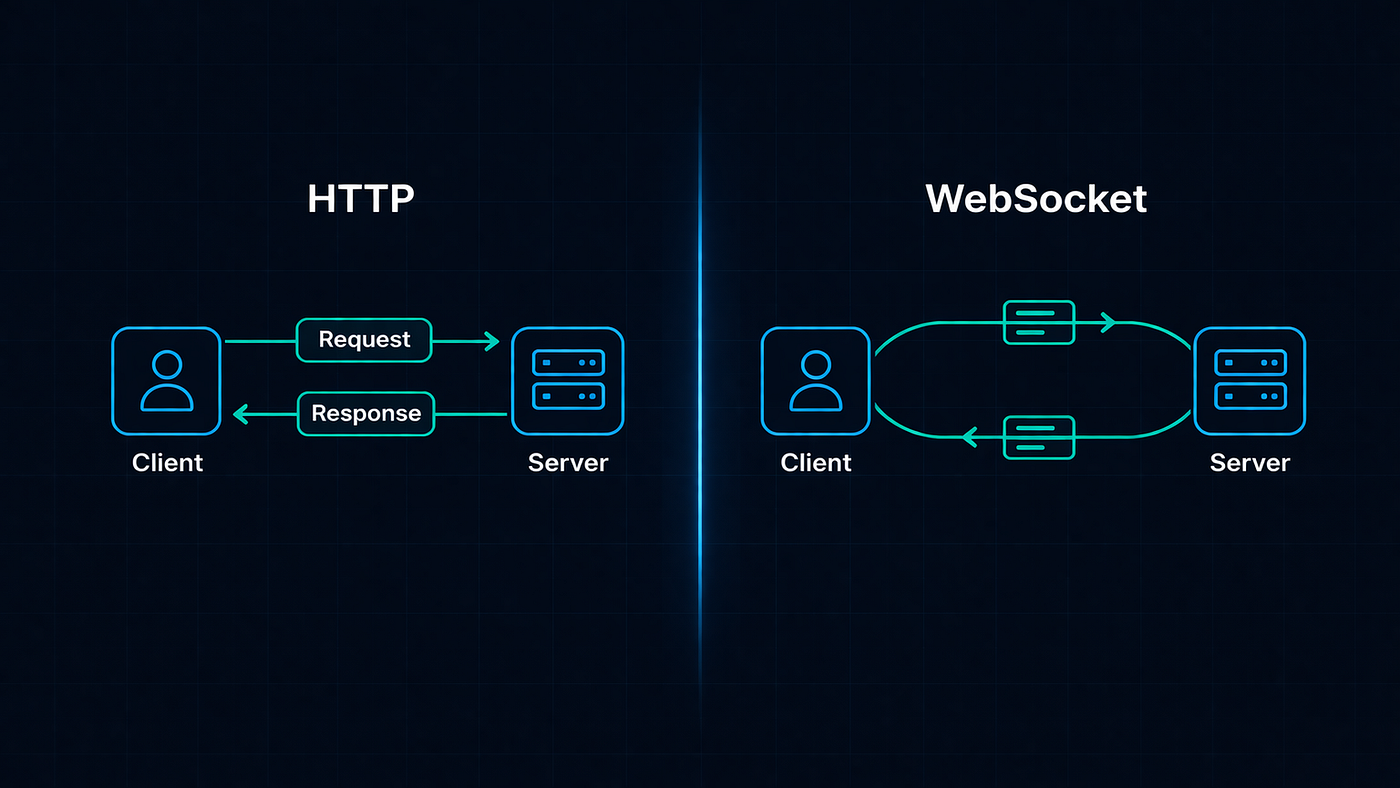
TL;DR Quick Answer: WebSocket real-time architecture enables persistent, bidirectional communication between clients and servers — but naively implementing it will collapse under load. The production-grade approach requires sticky sessions or a stateless fan-out layer (Redis Pub/Sub), horizontal scaling of WebSocket servers, heartbeat/reconnection logic, and careful memory management per socket. Done right, you can sustain 100K+ concurrent connections at under 50ms message latency.
When users expect live order tracking, collaborative editing, real-time dashboards, or instant chat — WebSocket real-time architecture is the engineering backbone that makes it possible. HTTP polling is dead. Long-polling is a band-aid. If you're building a modern product in 2025 and still reaching for REST endpoints to simulate live data, you're accumulating UX debt that compounds fast. At Apargo, we've architected WebSocket layers for SaaS platforms, internal ops dashboards, and live collaboration tools — and the patterns we've learned the hard way are exactly what this article covers.
Why WebSocket Real-Time Architecture Is Harder Than It Looks
The WebSocket protocol itself is simple. You upgrade an HTTP connection, and you now have a persistent, full-duplex TCP channel. A junior developer can get a working chat demo running in under an hour. The real challenge begins the moment you ask: "What happens when we have 50,000 users connected simultaneously across 6 server instances?"
That's where most teams hit the wall. The core problems are:
- State is local to a server process. A connected socket lives in memory on one machine. Broadcasting a message to all connected clients across multiple servers requires a cross-process communication layer.
- Horizontal scaling is not automatic. Load balancers by default route connections round-robin, which breaks socket continuity unless you configure sticky sessions or go stateless.
- Memory leaks are silent killers. Each open WebSocket connection holds memory. Leaked event listeners, zombie connections, and uncleaned subscriptions will slowly consume your heap.
- Network instability requires client resilience. Mobile clients, flaky WiFi, and proxy timeouts will disconnect users constantly. Your reconnection and message-replay logic must be bulletproof.
The Core Components of Production WebSocket Real-Time Architecture
Let's break down the architecture layer by layer, the way we actually build it at Apargo.
1. The WebSocket Gateway Layer
Your WebSocket servers are stateful processes. Each instance maintains an in-memory map of socketId → socket object. This is fast — O(1) lookups, sub-millisecond message delivery to a connected client. The problem is isolation: server A doesn't know about sockets on server B.
We typically run WebSocket gateway nodes separately from our HTTP API servers. They are lightweight, connection-focused processes tuned for high concurrency — not heavy computation. In Node.js with Socket.IO or raw ws, a single well-tuned instance can handle 10,000–25,000 concurrent connections depending on message frequency and payload size.
// Minimal production WebSocket server with ws library
const WebSocket = require('ws');
const http = require('http');

const server = http.createServer();
const wss = new WebSocket.Server({ server });

// Connection registry: socketId → ws object
const clients = new Map();

wss.on('connection', (ws, req) => {
  const socketId = generateUUID(); // assign unique ID
  clients.set(socketId, ws);

  // Attach metadata to the socket
  ws.meta = {
    id: socketId,
    userId: extractUserIdFromToken(req),
    rooms: new Set(),
    isAlive: true,
  };

  ws.on('message', (data) => handleMessage(ws, data));

  ws.on('close', () => {
    clients.delete(socketId);
    cleanupSubscriptions(ws.meta);
  });

  ws.on('error', (err) => {
    console.error(`Socket error [${socketId}]:`, err.message);
    clients.delete(socketId);
  });
});

// Heartbeat: detect zombie connections every 30 seconds
const heartbeatInterval = setInterval(() => {
  wss.clients.forEach((ws) => {
    if (!ws.meta.isAlive) return ws.terminate();
    ws.meta.isAlive = false;
    ws.ping(); // client must respond with pong
  });
}, 30000);

wss.on('close', () => clearInterval(heartbeatInterval));

server.listen(process.env.WS_PORT || 8080);
2. Redis Pub/Sub as the Fan-Out Backbone
This is the architectural keystone that makes WebSocket real-time architecture horizontally scalable. When server A needs to broadcast a message to a user whose socket lives on server B, it publishes to a Redis channel. Every WebSocket server subscribes to relevant channels and delivers the message to locally connected clients.
The result: your WebSocket servers become stateless in terms of routing logic. Any server can receive a publish event and forward it to whoever is connected locally. This pattern achieves near-linear horizontal scalability with Redis acting as the message bus.
// Redis Pub/Sub integration for cross-server broadcasting
const Redis = require('ioredis');

const publisher = new Redis(process.env.REDIS_URL);
const subscriber = new Redis(process.env.REDIS_URL);

// Subscribe to a channel namespace on startup
subscriber.subscribe('ws:broadcast', (err) => {
  if (err) throw new Error('Redis subscription failed: ' + err.message);
  console.log('Subscribed to ws:broadcast channel');
});

// When a message arrives on the Redis channel,
// deliver to all locally connected clients in the target room
subscriber.on('message', (channel, rawMessage) => {
  const { room, payload, excludeSocketId } = JSON.parse(rawMessage);

  clients.forEach((ws, socketId) => {
    if (
      socketId !== excludeSocketId &&        // don't echo back to sender
      ws.meta.rooms.has(room) &&             // client is in this room
      ws.readyState === WebSocket.OPEN       // connection is alive
    ) {
      ws.send(JSON.stringify(payload));
    }
  });
});

// Publish a message to all servers via Redis
function broadcastToRoom(room, payload, excludeSocketId = null) {
  publisher.publish('ws:broadcast', JSON.stringify({
    room,
    payload,
    excludeSocketId,
  }));
}

module.exports = { broadcastToRoom };
With this setup, we've measured end-to-end message latency of 12–35ms from publish to client delivery under normal load — well within the perceptual threshold for "real-time" UX.
3. Room Management and Authorization
Rooms (or channels) are logical groupings of sockets. A user might be in a project:123 room, an org:456 room, and a notifications:userId room simultaneously. Room membership must be validated on join — never trust the client to self-assign rooms.
// Secure room join handler
async function handleMessage(ws, rawData) {
  const message = JSON.parse(rawData);

  if (message.type === 'JOIN_ROOM') {
    const { room, token } = message;

    // Validate: does this user have access to this room?
    const authorized = await checkRoomAuthorization(ws.meta.userId, room);

    if (!authorized) {
      ws.send(JSON.stringify({ type: 'ERROR', message: 'Unauthorized room' }));
      return;
    }

    ws.meta.rooms.add(room);
    ws.send(JSON.stringify({ type: 'JOINED', room }));
  }
}
Scaling WebSocket Real-Time Architecture Horizontally
Load Balancer Configuration
WebSocket connections require the HTTP Upgrade handshake to succeed before the persistent connection is established. Most cloud load balancers (AWS ALB, NGINX, Cloudflare) support this natively — but you need to configure them correctly:
- Enable WebSocket protocol support explicitly in your load balancer rules.
- Set idle timeout to at least 3600 seconds (default 60s will kill long-lived connections).
- Use sticky sessions (session affinity) only if you haven't implemented Redis Pub/Sub — otherwise go stateless and route freely.
- Configure health checks on the HTTP port, not the WebSocket port, to avoid false negatives.
Kubernetes Deployment Considerations
Running WebSocket servers on Kubernetes introduces pod lifecycle challenges. When a pod is terminated (rolling update, scale-down), all connected clients on that pod are forcibly disconnected. Mitigate this with:
- Graceful shutdown handlers: On SIGTERM, stop accepting new connections, notify connected clients with a
RECONNECTmessage, and drain existing connections over 30–60 seconds before terminating. - PodDisruptionBudgets: Ensure at least N-1 pods remain available during rolling updates.
- Client-side exponential backoff reconnection: Clients should auto-reconnect with jitter to avoid thundering herd on pod restarts.
// Client-side reconnection with exponential backoff + jitter
function connectWithBackoff(url, attempt = 0) {
  const MAX_ATTEMPTS = 10;
  const BASE_DELAY_MS = 500;
  const MAX_DELAY_MS = 30000;

  const delay = Math.min(
    BASE_DELAY_MS * Math.pow(2, attempt) + Math.random() * 500,
    MAX_DELAY_MS
  );

  setTimeout(() => {
    const ws = new WebSocket(url);

    ws.onopen = () => {
      console.log('WebSocket connected');
      attempt = 0; // reset on successful connection
      rejoinRooms(ws); // re-subscribe to rooms after reconnect
    };

    ws.onclose = (event) => {
      if (attempt < MAX_ATTEMPTS) {
        console.log(`Reconnecting in ${delay}ms (attempt ${attempt + 1})`);
        connectWithBackoff(url, attempt + 1);
      } else {
        console.error('Max reconnection attempts reached');
        showOfflineBanner(); // degrade gracefully in the UI
      }
    };

    ws.onerror = (err) => console.error('WS error:', err);
  }, delay);
}
Memory and Performance Tuning
At scale, WebSocket real-time architecture becomes a memory management exercise. Each connection in Node.js carries roughly 5–10KB of base overhead plus your application-level metadata. At 50,000 connections, that's 250–500MB just for socket state — before any message buffering.
Key Optimizations We Apply at Apargo
- Binary messaging with MessagePack or Protocol Buffers instead of JSON — reduces payload size by 30–60%, cutting both bandwidth and serialization CPU cost.
- Throttle high-frequency events client-side. For live cursors or typing indicators, debounce at 50–100ms before sending. A collaborative doc with 20 users typing simultaneously should not generate 200 messages/second.
- Limit room sizes. Rooms with 10,000+ members should fan out through a dedicated broadcast worker, not inline in the message handler.
- Monitor heap usage per process. Set a memory ceiling (e.g.,
--max-old-space-size=2048in Node.js) and use process managers (PM2, Kubernetes liveness probes) to restart unhealthy instances automatically. - Use connection pooling for Redis. Each WebSocket server should maintain a single subscriber connection and a small pool of publisher connections — not one Redis connection per socket.
Observability: What You Must Monitor
You cannot operate a production WebSocket real-time architecture blind. These are the metrics we instrument at Apargo for every real-time system we ship:
- Active connections per server instance — alerts on sudden drops (mass disconnect event) or unexpected spikes.
- Message throughput (msgs/sec) — both inbound and outbound, segmented by room/channel type.
- Redis Pub/Sub lag — time between publish and delivery across servers. Should stay under 10ms at p99.
- Connection error rate — track upgrade failures, auth rejections, and abnormal close codes.
- Reconnection rate — a spike indicates network instability or a deployment event.
- Heap memory per WebSocket process — trend upward over time = memory leak. Investigate immediately.
When to Use WebSockets vs. SSE vs. HTTP/2 Push
Not every "real-time" use case needs WebSockets. Here's the decision matrix we use:
- Server-Sent Events (SSE): One-way server-to-client streams. Perfect for live dashboards, notification feeds, and log streaming. Simpler than WebSockets, HTTP/1.1 compatible, auto-reconnects natively. Use this if you don't need client-to-server messaging.
- WebSockets: Full-duplex. Use when the client also sends frequent messages — chat, collaborative editing, multiplayer, live forms.
- HTTP/2 Server Push:
Related Articles
Explore more insights from our engineering and product teams.

API Rate Limiting Strategies: How to Protect Your Backend Without Throttling Your Best Users
Most teams implement rate limiting as an afterthought — and pay for it with cascading failures, abuse incidents, and frustrated power users. This deep-dive covers the engineering patterns, algorithms, and tiered strategies that protect your infrastructure while keeping your best customers fast.
Progressive Web App Performance: How to Engineer PWAs That Feel Native, Load Instantly, and Outperform the App Store
Progressive Web Apps are no longer a compromise — when engineered correctly, they out-load, out-engage, and out-convert native apps. Here's the complete technical playbook to build PWAs that perform at production scale.

Online Document Verification: Detect Fake, Edited & AI-Generated Files Instantly
Learn how to verify documents online and detect fake, forged, edited, or AI-generated files instantly using VerifyDocs. Fast, secure, and AI-powered.